All research

Research 012026

Following every read back to memory.

Read-Trace Consistency in Accelerator Simulation

Two measurement windows13 / 17layer shapes with a different
set of fastest dataflows.
Context
FDUROP Xiyuan Program
Contribution
Study lead · three-student team
Focus
SCALE-Sim · Dataflow · Validation

Overview

Trace-based memory studies rely on the DRAM requests generated by an accelerator simulator. If a served read has no supporting transfer, the replay omits part of the memory traffic. We checked that correspondence in SCALE-Sim, then compared dataflow rankings across two measurement windows using configurations that passed the study’s admission checks.

01 contribution

From read traces to dataflow comparisons

I led a three-student team in the FDUROP Xiyuan Program, advised by Prof. Keren Zhu (CODA Lab). We developed a transfer-level consistency check for SCALE-Sim and evaluated 17 layer shapes from MobileNet V1 and DS-CNN-S on an 8×8 array, using output-, weight-, and input-stationary dataflows.

The question

Can every served read be traced to data that has already arrived?

A consistency check at the boundary between memory transfers and compute.

02 method

Checking reads and explaining false hits

The observer follows prefetch, refill, hit queries, and read service, preserving their arguments, return values, and simulated timing. For each requested address, it checks that a generated transfer exists, that the earliest recorded completion is no later than the read’s return, and that the return respects the configured hit latency.

Controlled probes identified two mechanisms behind false hits. Null slots occupy positions in the prefetch schedule, reducing the addresses covered by an initial transfer. The hit logic rounds its budget up to whole groups of non-null occurrences, which can expand the set of reported hits. All 27 probes agreed with the transfer-based references and the predicted hit budget.

A transfer exists for the requested address.

Data ready

tcomplete ≤ treturn

Minimum hit latency

tarrival + Lhit ≤ treturn

  • Prefetch
  • Refill
  • Hit query
  • Service

Address-level observer

Record each transfer.

Keep the earliest transfer completion time for each address.

Check each read.

Test address coverage and timing; record the first violating service.

Four observation points connect each read to its supporting transfer. The wrappers preserve the simulator’s arguments, return values, and timing.Original method diagram · slide 4

03 findings

What the read traces revealed

All 612 runs completed normally. The read-causality check found violations in 333 of the 459 buffer-constrained configurations; all 153 large-buffer controls passed. These checks expose inconsistencies between the simulator’s read path and the transfers or service times recorded for it.

Buffer-constrained grid

333 / 459

configurations failed the read check.

153 / 153large-buffer controls passed

Read-check failures by buffer capacity

153 configurations per capacity
  1. 144 / 153
    1Ki words
  2. 117 / 153
    4Ki words
  3. 72 / 153
    16Ki words
  4. 0 / 153
    512control
Buffer capacity S is measured per operand. Each capacity combines 17 layer shapes, three dataflows, and bandwidths of 1, 4, and 16 words/cycle.Original result chart · slide 5

The operand-fit boundary

Capacity, residency, and transferred addresses.

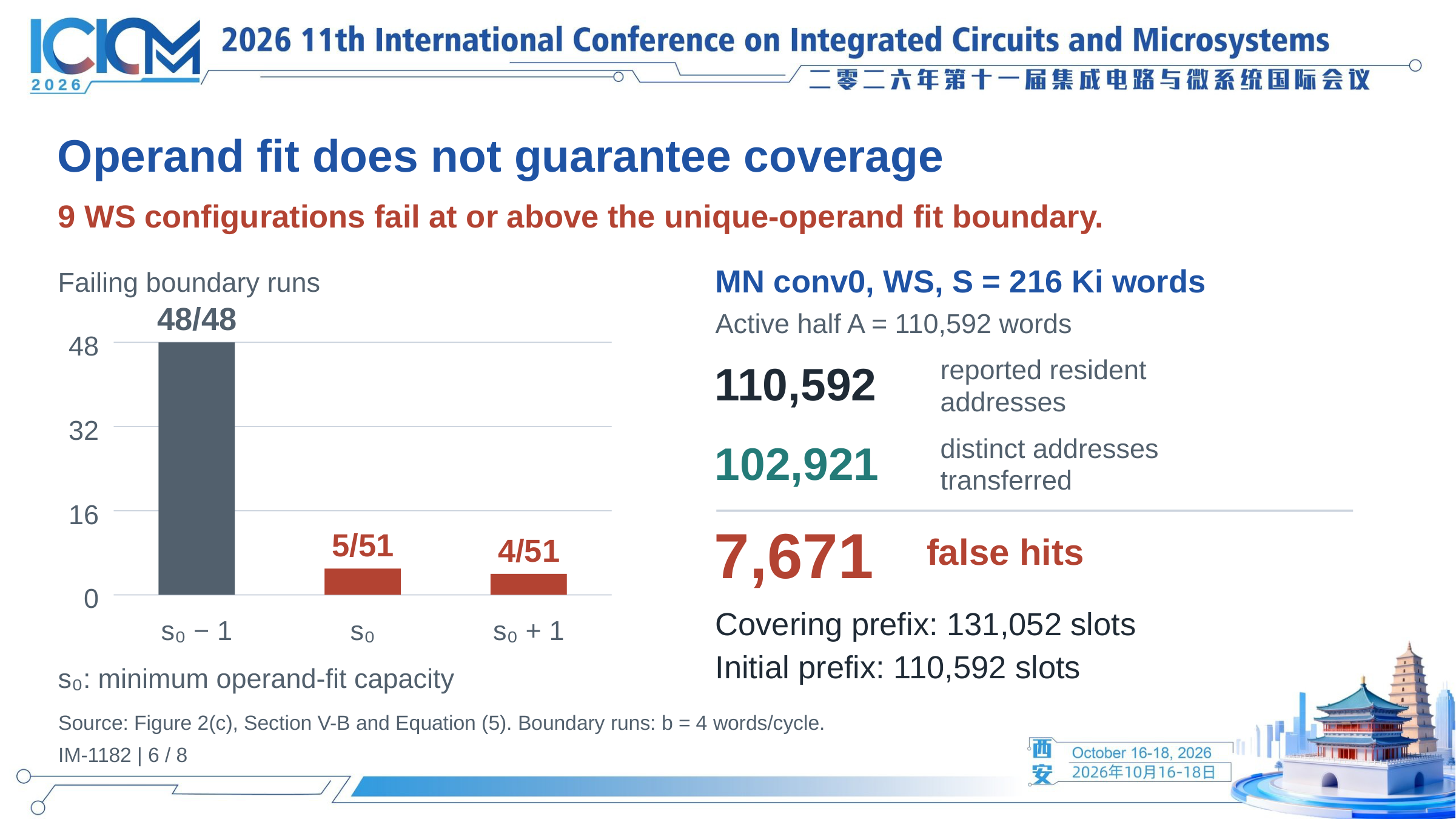
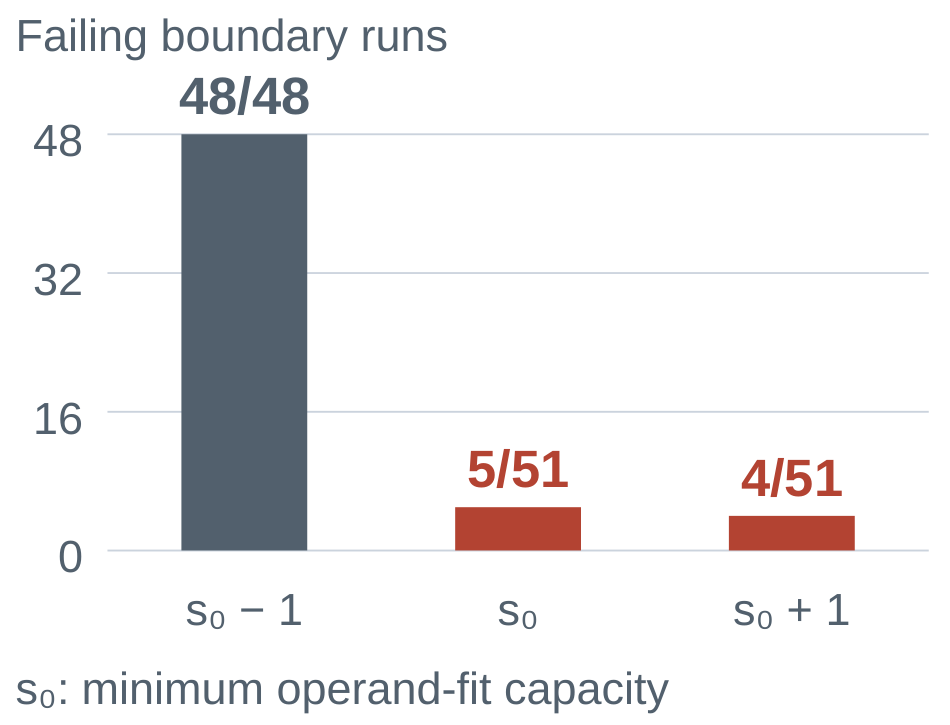
To examine the operand-fit boundary, we ran 150 configurations around the minimum capacity needed to hold each layer’s unique inputs and weights. Of the 102 configurations at or above that boundary, nine failed the check; all were weight-stationary. Their operands fit in the active buffer halves, yet the initial transfer missed addresses that the hit logic reported as resident.

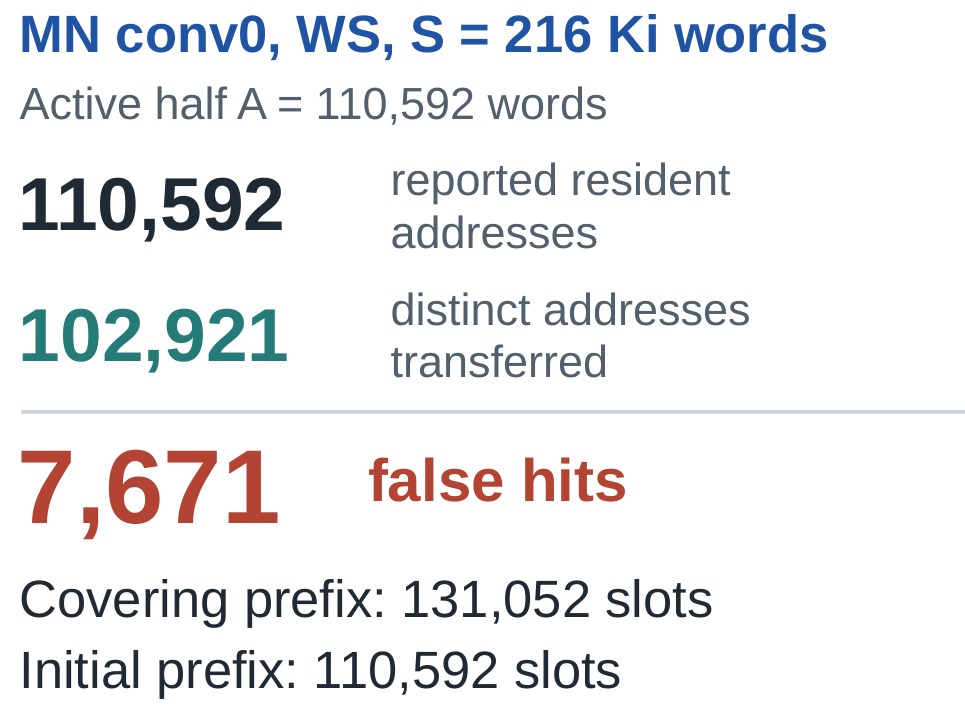
In MN conv0 at 216 Ki words per operand buffer, the WS hit logic reported 110,592 input addresses as resident. The initial transfer covered 102,921 distinct addresses, leaving 7,671 false-hit addresses. Its 110,592-slot schedule prefix was shorter than the 131,052 slots needed to cover all required input addresses.

Boundary failures at s0 minus 1, s0 and s0 plus 1, alongside an MN conv0 weight-stationary case with 110,592 reported resident input addresses, 102,921 distinct transferred addresses and 7,671 false-hit addresses.
Operand-fit boundary sweep: 48 of 48 failures below the boundary, 5 of 51 at the boundary, and 4 of 51 above it.MN conv0, weight-stationary, 216 Kiword buffer: 110,592 reported resident input addresses versus 102,921 distinct transferred addresses; 7,671 false-hit addresses. Covering prefix: 131,052 slots; initial prefix: 110,592 slots.
The operand-fit boundary and an address-coverage exampleThe operand-fit sweep uses a bandwidth of 4 words/cycle. The MN conv0 panels compare residency with transferred addresses and the prefetch-schedule prefix needed for coverage. Oral presentation, slide 6.View full resolution (new tab)

From trace consistency to design choice

Dataflow rankings depend on the measurement window.

We compared 51 configurations that passed the study’s admission checks. Switching between the compute field and the cold interval changed the set of fastest dataflows for 13 of the 17 layer shapes, with ties retained. In MN conv0, the same WS and OS runs reverse order between the two windows. A cycle count’s measurement window can therefore change the dataflow a designer would choose.

8×8 array · 512 Ki words per operand · 4 words/cycle

MN conv0 · cycles by measurement window
WindowWSOS
Compute field16,471lower20,991
Cold interval82,00656,830lower
Compute field
Time of the final SRAM service.
Cold interval
From the first input or weight DRAM read to the last output DRAM write.

WS: weight-stationary. OS: output-stationary.

Original comparison · slide 7

04 outcome

Presented at ICICM 2026

I presented the study at ICICM 2026 in Xi’an on 17 October 2026. My oral presentation received the Best Presentation Award (session).

2026Conference paper
& oral presentation

Beyond Capacity Checks: Read-Trace Consistency in Systolic-Array Simulator Evaluation

Yixuan Zhuang, Shiting Wang, Ruiyao Qin, and Keren Zhu

11th International Conference on Integrated Circuits and Microsystems (ICICM 2026)
Xi’an, China

Accepted conference paper

Best Presentation Award (session)

Further reading

Use Zoom in to inspect labels and details. Scroll or swipe to move around the image.